Butterfly Valves: Space and Cost Advantage on Large Diameters
On large-diameter lines, a butterfly valve instead of a gate valve usually saves space, weight and cost at once.
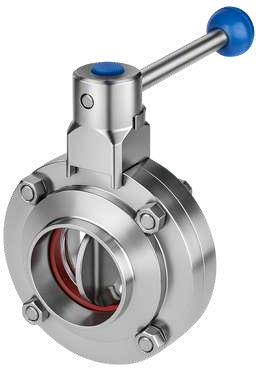
As diameter grows, the economics of valve selection change. On small sizes the difference in weight and face-to-face length between valve types is negligible; on large sizes that difference affects both the handling and installation method and the support design. This is why butterfly valves are so widespread.
Why a butterfly valve?
A butterfly valve works by a quarter-turn of a disc positioned in the middle of the pipe cross-section. Its body occupies roughly one disc thickness; it does not need the tall body a gate valve requires to retract the gate. The result:
- Short face-to-face length — can be decisive in tight plant rooms.
- Low weight — reduces handling, hanger and support loads.
- Quarter-turn operation — actuators are easy to fit.
Three connection types
Wafer type
Clamped between two flanges; it has no bolt holes of its own. It is the most economical and lightest solution. However, when the valve is removed the connection between the two flanges disappears entirely, so it cannot be removed without draining one side of the line.
Lug type
Separate bolts are fitted from each side into threaded lugs on the body. The valve stays attached on one side even if the other side is dismantled. This allows end-of-line service and single-sided maintenance — being able to take a piece of equipment out of service without isolating the whole line is a decisive criterion in many plants.
Double flanged type
It has its own flanges and behaves like a standard flanged connection. Weight and cost are higher, but it provides a more rigid connection on large diameters and under high loads.
What changes in hygienic applications?
In food, beverage and pharmaceutical processes the decisive factor is cleanability. Hygienic butterfly valves are made with a body geometry that leaves no dead volume where fluid can stagnate; surface roughness and seal material are selected for CIP/SIP cleaning cycles. Fitting a standard industrial butterfly valve into these applications creates problems in cleaning validation.
Limitations
- The disc is always in the flow. Even fully open, the disc and stem restrict the line somewhat; this is a disadvantage where very low pressure drop is required.
- Throttling is limited. A butterfly valve can throttle, but at small openings the flow accelerates at the disc edge and erodes the seat.
- Disc position during installation. The disc must not be partly open while the valve is fitted between flanges; the adjacent pipe or gasket can strike the disc and damage the sealing face.
Summary
On large diameters, a butterfly valve performs most isolation duties with less space and less weight. The real decision point is not the type but the connection style: lug type if maintenance without draining is required, wafer type if it is not.
From the catalog
Products mentioned in this article
The technical values of the products below are extracted from the company's printed catalog, not from the article text.
Read next
Related articles
Fire Line Fittings and Periodic Inspection
Fittings on a fire line may stand unused for years and must work first time at exactly the moment they are needed.
Check Valve Selection and Water Hammer
A check valve stops reverse flow; the real question is how quickly it stops it. A slow-closing check valve becomes the source of w...
Fitting Selection for Marine Applications
Three things stress a fitting on board: saltwater, continuous vibration and limited maintenance access. Selection follows all thre...
Let us select the right product for your project
You can write to our technical team with questions about the topic in this article.